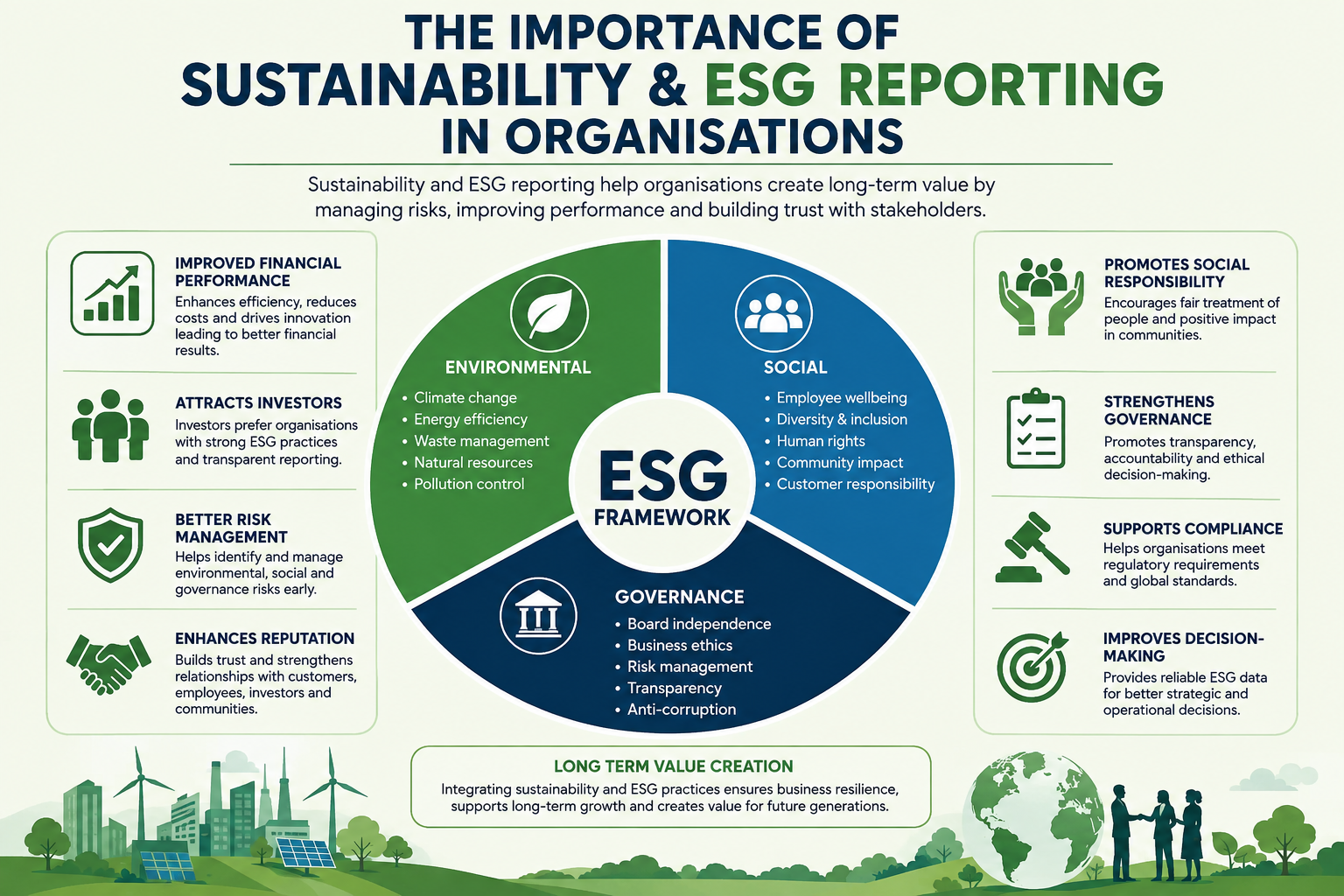
Importance
Sustainability refers to an organisation’s ability to operate and grow while considering its long-term economic, environmental, and social impacts. ESG (Environmental, Social and Governance) reporting is the process of communicating an organisation’s performance, risks, policies, and impacts in these three areas to stakeholders.
1. Environmental responsibility
ESG reporting helps organisations monitor and disclose their impact on the environment, including:
- Greenhouse gas emissions
- Energy and water consumption
- Waste management
- Pollution control
- Use of renewable resources
- Climate-related risks
This encourages organisations to reduce environmental damage and operate more efficiently.
2. Improved financial performance
Sustainability can reduce operating costs through:
- Energy efficiency
- Reduced waste
- Efficient use of raw materials
- Better resource management
For example, investing in energy-efficient equipment may reduce electricity costs over the long term.
3. Attracting investors
Investors increasingly consider ESG factors when deciding where to invest. Good ESG performance can demonstrate that an organisation:
- Manages risks effectively
- Has responsible leadership
- Is prepared for future environmental and regulatory changes
- Has sustainable long-term growth prospects
Consequently, strong ESG reporting can improve access to capital and investment.
4. Better risk management
ESG reporting helps management identify risks that traditional financial statements may not fully capture.
Examples include:
- Climate change risks
- Supply-chain disruptions
- Labour disputes
- Corruption and fraud
- Regulatory changes
- Reputational damage
Identifying these risks early allows management to develop appropriate controls and mitigation strategies.
5. Enhances corporate reputation
Organisations that demonstrate responsible environmental, social and governance practices can build greater trust among:
- Customers
- Employees
- Investors
- Regulators
- Suppliers
- Communities
A strong ESG record can therefore become a competitive advantage.
6. Promotes social responsibility
The social component of ESG focuses on how an organisation treats people and communities. Reporting may cover:
- Employee health and safety
- Diversity and inclusion
- Employee development
- Human rights
- Fair wages and working conditions
- Customer protection
- Community development
This encourages organisations to consider their wider social responsibilities rather than focusing only on profits.
7. Strengthens corporate governance
The governance component addresses how an organisation is managed and controlled. It may include:
- Board structure and independence
- Business ethics
- Anti-corruption measures
- Risk management
- Internal controls
- Executive remuneration
- Transparency and accountability
Good governance reduces the likelihood of fraud, corruption and poor management decisions.
8. Supports regulatory compliance
Governments and regulators are increasingly introducing sustainability and climate-related requirements. ESG reporting helps organisations prepare for and demonstrate compliance with applicable requirements.
It also makes it easier for auditors, regulators and other stakeholders to assess the organisation's non-financial performance.
9. Improves decision-making
ESG information gives management additional information for strategic decisions.
For example, management can use ESG data to determine whether to:
- Invest in renewable energy
- Change suppliers
- Reduce carbon emissions
- Improve employee welfare
- Strengthen corporate governance
- Develop environmentally friendly products
10. Builds stakeholder confidence
Transparent ESG reporting demonstrates that an organisation is willing to disclose both its achievements and its risks.
This can improve relationships with shareholders, employees, customers, government agencies and the surrounding community.
11. Supports long-term business sustainability
An organisation that focuses only on short-term profits may expose itself to environmental, social, regulatory and reputational risks.
Sustainability encourages management to balance:
Profitability + People + Planet + Good Governance
This supports the organisation's ability to survive and grow over the long term.
12. Provides a competitive advantage
Strong ESG performance can differentiate an organisation from competitors. Customers may prefer responsible businesses, employees may prefer organisations with good workplace practices, and investors may favour companies with effective ESG strategies.